
By Yu Zhang
Chinese Animation: Multiplicities in Motion marks a decisive moment in the institutionalization of Chinese animation studies. Emerging from the 2021 inaugural conference of the Association for Chinese Animation Studies (ACAS), the volume does more than collect essays: it declares the consolidation of a field. Published by Harvard University Asia Center, it signals that Chinese animation studies as a field has moved from the margins of Chinese film studies and global animation studies into a self-conscious and internationally recognized domain. In their substantial introduction, the editors offer what amounts to a “statement of the field.” They trace the development of Chinese animation studies from scattered essays in the 1990s, to general histories in the early 2000s, and to the surge of specialized scholarship since the mid-2010s. This acceleration, they argue, was driven by the global expansion of animation studies, the accessibility of animation via streaming platforms, the rapid growth of China’s domestic animation industry, and increased state investment (p. 3). By narrating this trajectory, the editors provide the field with its first coherent self-history, which is an important step in disciplinary formation.
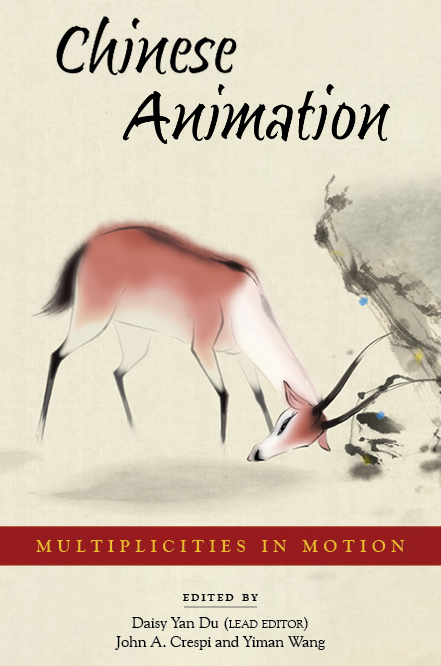
Conceptually, the volume is anchored in Sergei Eisenstein’s notion of “plasmaticness,” which the editors use as a metaphor for methodological openness and formal flexibility (p. 5). They also adopt Gayatri Spivak’s concept of “strategic essentialism,” retaining the term “Chinese” as a necessary organizing category while critically interrogating its limits (p. 6). The volume’s most sophisticated contribution is its handling of the national signifier in its own title. By invoking “strategic essentialism”—using “Chinese” as a provisional and tactically necessary label while systematically deconstructing its implications—the editors showcase a sophisticated way to manage its most fraught conceptual commitment of a field. The book spans mainland China, Taiwan, Hong Kong, and Singapore, and ranges from silent-era cinema to digital VR. Its breadth is itself an argument: Chinese animation is heterogeneous, transregional, and historically layered.
The late Yingjin Zhang’s keynote essay provides the volume’s master framework: Chinese animation as media archaeology. By arguing that Chinese animation constitutes an “alternative archive of Chinese film history” (p. 16) governed by “multiple lines of descent” rather than teleological development (p. 14), Zhang gives the field a historiographic method distinct from the periodization schemes of Chinese film studies and the auteur-centered approaches of Western animation studies. His tripartite concept of dispositif — medium, image, spectator — provides a portable analytical tool specifically calibrated to animation’s intermedial character.
In “Section 1: Juncture,” Panpan Yang examines moments in 1920s–30s Chinese silent films where inanimate objects appear to move in otherwise live-action works. She demonstrates that these effects were achieved through stop-motion, wires, or both. By foregrounding stop-motion, Yang repositions early Chinese animation within photographic trick cinema, arguing that its history cannot be understood solely through animated cartoons but must be situated within silent-era cinematic practices. Jinying Li explores the historical and aesthetic affinities between Chinese animation (donghua pian) and martial arts cinema (wuxia pian). Sharing roots in shadow play, the Monkey King mythos, and figures like the Wan brothers, both forms employ techniques such as stop-motion, CGI, exaggerated sound, plasmatic physics, and extreme verticality. Li argues that they emerged as parallel responses to “false movement,” negotiating modern space, time, and vitality while articulating nationalist “Chineseness.” Linda C. Zhang focuses on 1950s–early 1960s puppet animation, showing how it drew on folk literature, opera, and traditional puppetry while redefining itself as a socialist modern medium. In early PRC films, puppets and toys model technologically mediated creative labor, promoting social responsibility and nation-building. The “toy” becomes a mass pedagogical tool aligned with state cultural goals. Shasha Liu traces a 1980s shift from grounding animation in traditional art forms to emphasizing cinematic techniques. Comparing The Deer of Nine Colors (1981) and Jiazi Saves the Deer (1985), she contrasts a National Style, fine-arts approach with one foregrounding shot construction and linear storytelling. The debate reflects a broader redefinition of animation’s medium identity through intermedial ties to mural painting and picture books.
In “Section II: Gender,” Tim Shao-Hung Teng analyzes the Taiwanese feature film Grandma and Her Ghosts (1998), which blends family melodrama with folk religion. Centering on a shaman grandmother and her urban grandson, the film challenges Japanese and American animation norms. Teng shows how the grandmother functions as both ethnographic figure and media theorist, illuminating questions of medium specificity, spectatorship, and turn-of-the-millennium Taiwanese culture. Daisy Yan Du reconsiders gender and authorship in Shanghai Animation Film Studio productions (late 1940s–1980s). In a collectivist, state-controlled system prioritizing class over gender, articulating a distinct female aesthetic was difficult. By focusing on children’s animation, Du reframes women practitioners as “socialist cine-feminists” whose obscured yet formative labor shaped Chinese animation history. Paola Voci proposes the term “animateur” for contemporary practitioners who blend artistic and artisanal practices across mainstream and avant-garde, local and global contexts. Marked by mobility and accented positionality, women animateurs assert agency through minor, understated “feminist gestures” that reconnect representation with production and blur boundaries between theory and practice, art and politics.
In “Section III: Identities,” Shannon Brownlee revisits Chinese ink-painting animation, detailing how late-1950s Shanghai animators adapted the multiplane camera to simulate ink diffusion, fusing traditional painting with cinema. She argues that ink-painting animation is not simply East versus West but fundamentally transcultural, shaped by analog experimentation, digital brush technologies, and global circulation. Jasmine Yu-Hsing Chen reads the animated series The Little Sun (2010) as an allegory of “homemaking” for Chinese immigrants in Taiwan. Drawing on Tuan Yi-Fu’s space/place distinction, she argues that animation transforms abstract political space into affective place through local memory and everyday objects, subverting KMT China-centric imaginaries of homeland. Jessica K. Chan recovers the Old Master Q trilogy (1981–83), Hong Kong’s first animated feature series. Its rapid shift from kung fu to wuxia to sci-fi reflects colonial-capitalist modernity during Sino-British negotiations. Through “animation as action,” the films remediate icons like Bruce Lee and E.T., challenging live-action cinema’s claims to corporeal authenticity.
Section IV turns to digitality with two essays. Wendy Larson examines Flash animation sequences in Jia Zhangke’s The World (2004). Triggered by text messages, these interludes express migrant workers’ inner desires within Beijing World Park’s counterfeit cosmopolitanism. While live action documents constrained mobility, animation provides imaginative agency unavailable to realist cinema. Yiman Wang uses Light Chaser’s Cats and Peachtopia (2018) to theorize Chinese 3D digital animation. Combining perceptual realism, Halberstam’s “Pixarvolt,” and materialist critique, she argues that the studio’s ambition to become “China’s Pixar” exposes both the promise and paradox of realism in digital animation, which produces images without indexical referents.
In “Section V: Practices,” Jake Junjie Zhang documents the first generation of Chinese VR animation (2015–2018), focusing on studios such as Light Chaser, Pinta, and Sandman. He outlines challenges of immersive storytelling—viewer-guided narrative, spatial framing—and highlights experimental successes like Hypnosis: Reveries. The boom quickly contracted after 2018 due to an underdeveloped consumer market. Isabel Galwey surveys Hong Kong independent animation during the digital turn (1995–2005) around the 1997 handover. Drawing on IFVA records and animator accounts, she shows how digital technologies enabled transmedia experimentation while extending earlier independent traditions, creating a “kaleidoscopic” media landscape. Hannes Rall and Emma Harper’s chapter justifies the inclusion of Singapore within a volume on Chinese animation by complicating the notion of diasporic “Chineseness” in a multicultural nation where ethnic Chinese identity coexists with strong Southeast Asian and global influences. It argues that Singaporean animation, though shaped by Chinese heritage, draws equally on Malay, Indonesian, Western, and regional artistic traditions, resulting in hybrid forms that reflect contemporary concerns such as community life in HDB estates. The authors explore how immersive media can preserve and transform traditional performance, proposing expanded animation as a site where a distinctly Singaporean identity rooted in unity through diversity can emerge.
This edited volume represents an important milestone in Chinese animation studies. It is the first sustained account to present the field’s development as a coherent narrative with recognizable phases, turning points, and a clear trajectory. Chinese Animation brings together historical reflection, new archival work, theoretical innovation, diverse methods, broad geographic coverage, and international engagement into a single statement. As the editors describe, the volume “converted all these plasmatic multiplicities into the conventionally fixed form of an edited volume” (p. 7). It is significant because it marks the transition from an emerging field to an institutionalized one. In this sense, it is both a scholarly achievement and a cultural enterprise.
While working in Hong Kong over the past seven years, I have watched the field evolve from scattered essays into a growing number of monographs on Chinese animation, including Animated Encounters: Transnational Movements of Chinese Animation, 1940s–1970s (University of Hawai‘i Press, 2019) by the lead editor, Daisy Yan Du. International conferences and workshops on Chinese animation have become more frequent—for example, the semester-long conference organized by Daisy Yan Du at HKUST. The Association for Chinese Animation Studies has been established in Hong Kong in August 2015 and maintains an active online presence with publications and announcements. Edited collections focused on Chinese animation have proliferated, culminating in this volume. The field’s development is as inspiring as the book itself and serves as an instructive entrepreneurial model for readers to emulate and reflect upon. As the editors hope the volume will be read, it functions “as a guide to the alliances, attachments, diffusions, mimicries, and translations that pervade Chinese animated motifs, motions, genres, interfaces, and irruptions from Tang-dynasty Mogao cave murals to Kung Fu Hustle” (p. 7).
Bio:
Yu Zhang is Associate Professor in the Department of Chinese History and Culture at the Hong Kong Polytechnic University. She is the author of Going to the Countryside: The Rural in Modern Chinese Cultural Imagination, 1915-1965 (University of Michigan Press, 2020).
, John A. Crespi, and Yiman Wang. Harvard University Asia Center, 2025. 464 pp. Harvard Contemporary China Series 21.)