By Yuzhe Li
Amid the innovation-oriented climate of the Great Leap Forward, cutout animation (jianzhipian 剪纸片) emerged as a new animation category at the Shanghai Animation Film Studio.[1] Beginning with Pigsy Eats Watermelon (Zhubajie chigua 猪八戒吃瓜, 1958), cutout animation quickly established itself as a distinct and recognizable form within Chinese animation. Rather than remaining historically bounded, the form demonstrated remarkable durability, with its appeal extending well beyond the Mao era into the 1980s and 1990s, most famously through the cutout animation series Calabash Brothers (Hulu xiongdi 葫芦兄弟, 1986) and its sequels, while continuing to inform later animation practices in hybridized ways.[2] This form animates paper-cut figures by placing jointed paper puppets flat on an animation stand amid separately produced scenic layers, with movement generated through meticulous frame-by-frame manipulation of the puppets’ joints to produce the illusion that the figures have come to life. Among the contemporaneous stop-motion forms in Mao-era China that drew on folk arts and crafts, including puppet animation (mu’oupian 木偶片) and paper-folding animation (zhezhipian 折纸片), cutout films occupied a distinct artistic position because of their radical reliance on material flatness. More than any other Mao-era stop-motion form, they developed a visual regime grounded in planar materiality rather than in volumetric objects, turning flatness itself into an aesthetic principle in its own right.
This commitment to planar materiality, however, did not necessarily produce a flat visual world. Instead, cutout animation frequently engages spatial depth to generate a range of aesthetic formations and political effects. This makes cutout animation a critical site for examining the impulse to render space—whether as a spatial representation governed by real-world visual logic or as an expressive spatial construction shaped by formal and socio-political concerns. Scholars have noted the particularly productive role animation plays in rethinking space and spatial experience. For example, as Aylish Wood argues, despite the centrality of cinematic space to narrative meaning, live-action cinema rarely renders spatial change itself visible; by contrast, animation, especially in works in which space “exists on the screen as an event in itself,” foregrounds spatial transition and transformation and thereby enables a direct experiential encounter that revitalizes cinematic space.[3] In cutout animation, space becomes a more explicit representational concern because the materiality of its foundational medium—cardboard—foregrounds the problem of spatial depth from the outset. Unlike pliable paper, cardboard’s rigidity imposes specific constraints on spatial representation. In particular, the flatness of cardboard figures restricts their capacity for movement in three-dimensional space: as the prominent stop-motion animator Jin Xi 靳夕 (1919–1997) notes, “The characters can only move laterally across a single flat plane, without the ability to perform movements in depth.”[4] While Jin’s comment refers primarily to the restricted depth of figure movement, the same material limitation also affects the representation of space. In cutout animation, spatial depth is not given in advance in the way it often is in live-action cinema or volumetric puppet animation, nor is it as readily available as in cel animation, where perspectival drawing can more easily produce the illusion of three-dimensional space on a two-dimensional plane. Rather, it must be deliberately constructed through negotiation with the medium’s material flatness.
In this essay, I examine divergent spatial configurations through the work of two emblematic cutout animators: Wan Guchan 万古蟾 (1900–1995) and Qian Yunda 钱运达 (b. 1928). On the one hand, Wan formulates a spatial realism that organizes relations between figures and environments through what I call “compositional depth” and “navigational depth,” thereby transforming Chinese folk arts from ornamental emblems of national culture into structural components of a credible animated world and fostering a shared communal affect as viewers come to recognize and identify with that realist space. On the other hand, Qian develops anti-realist depth as a spatial and graphic logic for visualizing antagonistic figures, deploying a comic-inflected style to construct allegorical and revolutionary narratives that spatially demarcate those figures from the collective endowed with socialist and revolutionary legitimacy. Through a comparative analysis of these two animators’ contrasting spatial aesthetics, I argue that depth emerges not only as a technical and aesthetic problem but also as a politically consequential spatial logic in socialist China. This dual status, in turn, makes cutout animation a critical site for examining how spatial organization both configures and unsettles animated realism, understood here, following Marc Steinberg, less as a relation to the profilmic real than as an effect grounded in the cinematic conventions of realist representation—an effect long pursued through animation techniques designed to reproduce cinematic depth, from Disney’s multiplane camera to more recent three-dimensional computer-generated imagery.[5] Cutout animation shows that animated realism need not arise from volumetric simulation alone, but can also be produced through the orchestration of depth from comparatively rigid two-dimensional components, including flat, jointed paper-cut puppets and scenic elements; at the same time, Wan and Qian’s contrasting uses of such depth, which foster communal identification in one case and class antagonism in the other, reveal that the spatial organization underpinning animated realism is also politically consequential.
Wan Guchan’s approach to spatial depth in cutout animation closely aligns with Disney’s hyper-realist model, whose key features will become clearer in what follows, in that spatial relations remain visually coherent and perceptually stable. Such an approach is rooted in his close relationship with American animation conventions, shaped by the influence of Fleischer and Disney films during his early career from the 1920s to the 1940s.[6] Although Disney’s early animations of the 1920s exemplified Sergei Eisenstein’s notion of “plasmaticness”—the dynamic capacity to escape fixed form and assume any shape—in their visual language, the studio’s output after 1927 gradually abandoned this mode in favor of a neo-realist aesthetic that privileged verisimilitude in characters, settings, and narrative coherence.[7] The technical development of the multiplane camera further intensified Disney’s alignment with photographic realism, as painted images on multiple movable glass planes allowed the camera to traverse space while maintaining perspectival coherence. Building on this shift, Paul Wells adopts Umberto Eco’s term “hyper-realism” to describe Disney films and their imitators, framing hyper-realism as an aesthetic pursuit that became conventionalized during what Chris Pallant identifies as the “Disney-Formalist period,” which lasted from the early 1930s through the early 1940s.[8] Wells defines hyper-realism through four correspondences with the real world: visual design, context, and action mirror live-action cinema; characters, objects, and environments obey real-world physical laws; sound is diegetically and contextually appropriate; and bodies move and behave like real human beings and creatures.[9] Wan Guchan’s animation style demonstrates a shift similar to Disney’s. Whereas his early collaborative animations with the other Wan Brothers, particularly Princess Iron Fan(Tieshan gongzhu 铁扇公主, 1941), exhibit a stronger inclination toward plasmaticness than toward a realist cinematic visuality modeled on live-action film, his cutout animations of the 1950s and 1960s instead reveal a deliberate effort to produce, within the constraints of cutout materiality, a hyper-realist effect closer to Wells’s definition. This orientation finds its clearest expression in his treatment of spatial depth.
Wan Guchan’s cutout films exhibit two overlapping yet discernible forms of spatial depth. The first, which I term compositional depth, produces a convincing illusion of depth through the photographic-realist organization of diverse spatial cues within a single frame. In most frames of Wan’s cutout films, the compositions operate within a unified quasi-perspectival logic grounded in real-world visual principles, such as geometric modeling of volume and the reduction of scale with distance, thereby regulating the relative size and placement of figures and settings. The function of this depth is to render pictorial space perceptually intelligible by aligning it with the everyday experience of three-dimensional space. Such compositional depth recurs throughout Wan’s cutout films, from the pronounced volumetric articulation of Pigsy’s nose in his first cutout film, Pigsy Eats Watermelon (1958), whose protruding form enables the watermelon rind to hook onto it and rotate (Fig. 1), to the more fully elaborated spatial environments that structure characters’ living worlds in his early 1960s productions. The opening sequence of the award-winning Ginseng Boy (Renshen wawa 人参娃娃, 1961) provides a particularly telling example of Wan’s compositional depth. In one scene, a long shot visualizes the mountain road the child-laborer protagonist must traverse each day to work for an oppressive landlord, employing larger-nearer and smaller-farther scaling to create spatial recession. The mountain path gradually narrows as it recedes into space, ending in a gate reduced in size by its implied distance; by contrast, a foreground rock is rendered at an exaggerated scale to intensify spatial contrast (Fig. 2). In another scene, photographic realism is reinforced through a carefully ordered multiple-layer composition: silhouetted tree trunks and foliage anchor the foreground along the right edge; a bird’s-eye view of the landlord’s courtyard occupies the middle ground as the compositional center; and bluish-green distant mountains in the middle and upper-right zones evoke atmospheric perspective in the background (Fig. 3).[10] All these depth-producing devices consolidate a spatially coherent environment that renders the animated subject’s living world diegetically plausible and perceptually credible.

Fig. 1: The volumetric articulation of Pigsy’s nose in Pigsy Eats Watermelon (1958)

Fig. 2: Spatial depth in Ginseng Boy (1961) structured by larger-nearer and smaller-farther scaling
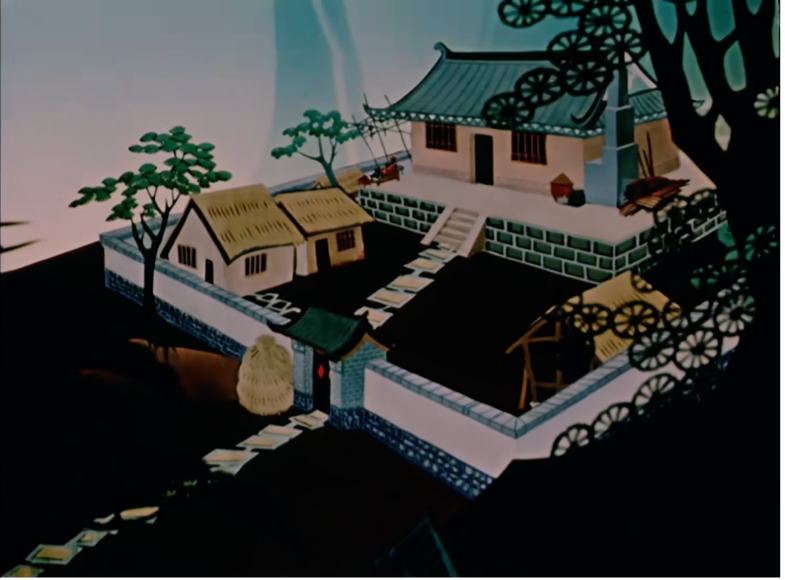
Fig. 3: Spatial depth structured through a multiple-layer composition in Ginseng Boy (1961)
A second form of spatial depth in Wan Guchan’s cutout films is what I call navigational depth, which frequently operates in tandem with compositional depth, though in particular sequences either mode may assume the dominant structuring role. Whereas compositional depth foregrounds a relatively static viewpoint that often evokes linear perspective, navigational depth emphasizes mobile viewpoints that guide the viewer through unfolding spatial transitions. Enabled chiefly by the coordinated movement of layers and the camera (Fig. 4),[11] this form of depth is commonly used to structure opening sequences, establish the primary diegetic environment in which the protagonists act, and draw the viewer into that narrative space. Ginseng Boy, discussed earlier in relation to compositional depth, already contains traces of navigational depth, as camera zooms and vertical movement modestly extend the viewer’s access to the spatial field. This strategy is more structurally pronounced in Wan’s two cutout films produced in 1959 to commemorate the founding anniversary of the People’s Republic of China, Fisherboy (Yutong 渔童) and Ji Gong’s Cricket Fight (Jigong dou xishuai济公斗蟋蟀). In Fisherboy, the opening sequence incorporates a zoom-in effect through the combined movement of the camera and the coordinated shifting of spatially separated planes, with superimposition used at several points to smooth the transition between successive spatial views. The movement carries the viewer progressively inward, from church spires to distant rooftops, then to clustered fishing boats, and finally to a centered view of fishermen’s thatched huts (Fig. 5). The opening of Ji Gong’s Cricket Fight offers another instance of navigational depth, this time through a horizontally moving viewpoint. As the view moves laterally, the frame shifts from garden walls and pavilion roofs to rockeries, bamboo, corridor posts, and railings, while dark foreground forms intermittently slide across the image to occlude and reveal the view; the movement culminates at a gate through which a group of hazy figures can be dimly seen in the inner courtyard, just as the servant moves toward it (Fig. 6). In both examples, navigational depth operates as a spatial mechanism that fosters immersion in the animated world by inviting the audience to share the camera’s mobile viewpoint.


Fig. 4: Navigational depth produced by coordinated layer movement and camera motion: top, vertical movement; bottom, horizontal movement
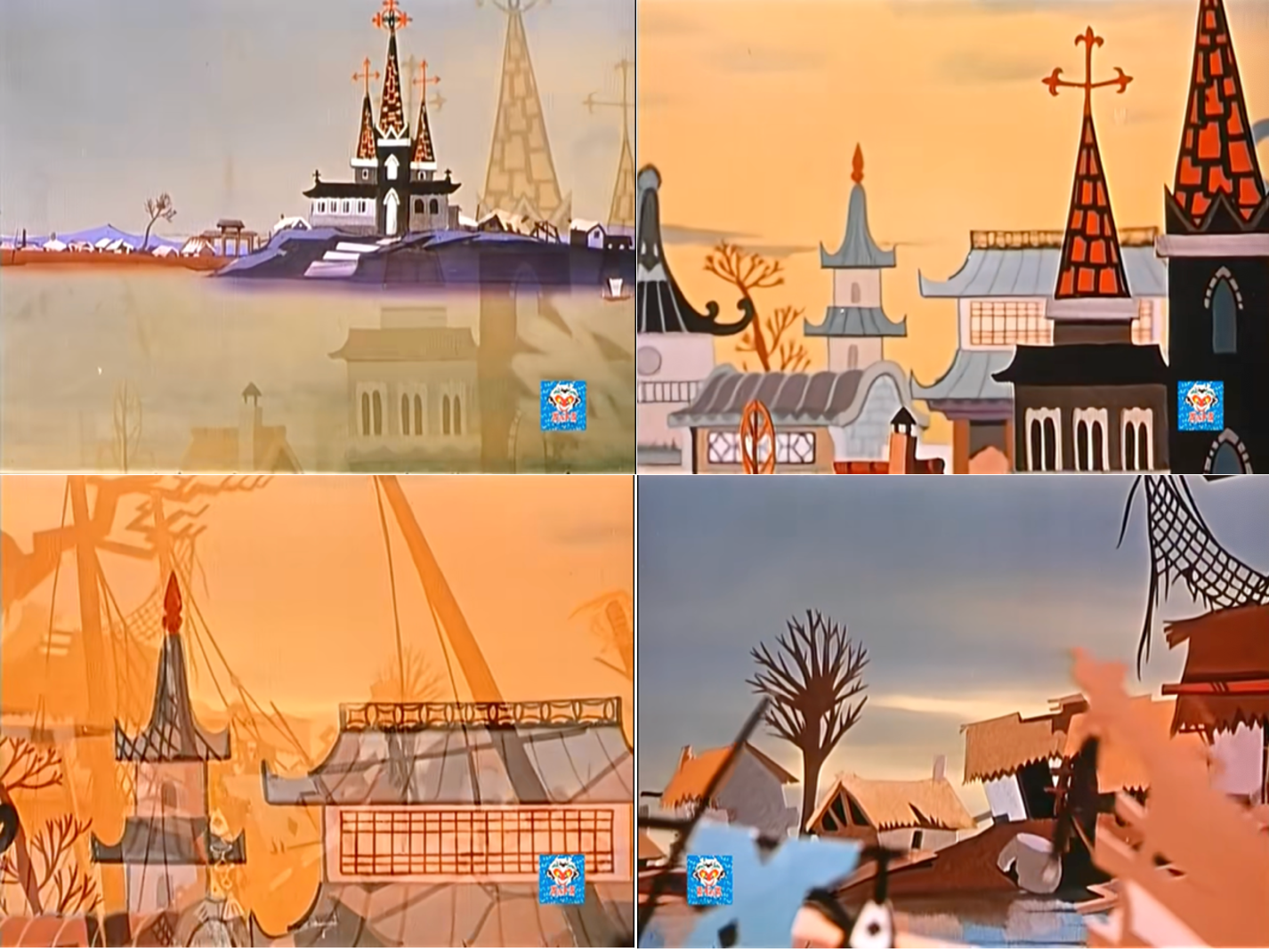
Fig. 5: Selected shots from the opening sequence of Fisherboy (1959), arranged from top left to top right, then bottom left to bottom right


Fig. 6: Selected shots from the opening sequence of Ji Gong’s Cricket Fight (1959), arranged from top left to top right, then bottom left to bottom right
Throughout Wan Guchan’s cutout films, the interplay of compositional and navigational depth plays a decisive role in producing an illusion of spatial realism that offsets the inherent flatness of paper-cut materiality. The aspiration toward spatial realism recalls a longstanding tension confronting artists working in planar media—what John White, in his study of the historical formation of pictorial space in European art, describes as one “between the artist’s desire to portray the world of space in which he lives and his feeling for the individuality, and essential flatness, of the surface upon which he works.”[12] Wan’s pursuit of spatial realism in cutout animation may likewise be understood as part of this broader tension in planar art. His own recollections indicate, moreover, that this pursuit was informed by a sustained engagement with Western painting. Reflecting on his early artistic formation, he explicitly links his attraction to Western art to its perspectival and chromatic means of representing the world more fully, and he treats such methods as a necessary stimulus for renewing Chinese art, in contrast to what he saw as the formulaic narrowness of certain late literati practices in traditional Chinese painting.[13] Yet the material flatness of cardboard in cutout animation means that spatial depth cannot be achieved through any direct transplantation of Western illusionism or linear perspective. What visual techniques, then, enable Wan to construct spatial depth within the material constraints of cutout animation? In this context, Wu Hung’s account of the spatial logic of Chinese painting offers useful insight into the problem. Wu argues that Chinese pictorial space operates through nonlinear modes of perspective.[14] He therefore turns to the traditional concept of jingying weizhi 经营位置, or the “strategic arrangement of positions,” to explain the distinctive spatial logic of Chinese painting: unlike the Western category of “composition,” which often carries implicit perspectival assumptions, jingying weizhi foregrounds the artist’s deliberate arrangement of pictorial elements without presupposing a rationalized system such as linear perspective.[15] Wan’s approach to spatial realism reflects a similar conceptual logic. The sense of depth arises from the strategic organization of cutout figures in relation to their surroundings—though this organization unfolds not on a single surface, as in painting, but across multiple stratified planes—rather than from the precise geometric calculation and rendering of three-dimensional form. His cutout films thus combine a Western-derived aspiration toward perspectival realism with the spatial methods of traditional Chinese painting and the aesthetic vocabulary of Chinese folk arts, especially window paper-cuts and related carving practices. Together, they transform paper-cut forms from ornamental signifiers of national culture into integral components of a credible and inhabitable animated world in which Chinese folktales and legends are brought to life, and in so doing materialize the “national style” (minzu fengge 民族风格) that Mao-era animators so often sought to achieve.[16]
Whereas depth in Wan Guchan’s cutout films operates as a spatial worlding mechanism that enhances animated realism, Qian Yunda, a leading figure of Chinese animation’s second generation, develops a distinctly different aesthetic of visual depth. Qian Yunda began his career in graphic arts, where he produced New Year prints, pictorial storybooks, and propaganda posters. His trajectory shifted in 1954, when the state sent him to study animation, especially puppet film, at the Academy of Arts and Crafts in Prague. After returning to China from Czechoslovakia in 1959, he joined the Shanghai Animation Film Studio, and his early studio projects included short propaganda films in a satirical, comic-book style, designed to celebrate exemplary socialist figures or critique American imperialism. In the 1960s, Qian started to experiment with cutout animation in works such as Silk Waistband (Siyaodai 丝腰带, 1961) and Red Army Bridge(Hongjunqiao 红军桥, 1964), and served as associate director on Wan Guchan’s The Golden Conch (Jinse de hailuo 金色的海螺, 1963).[17]
Yet both Silk Waistband and Red Army Bridge are marked by a pronounced caricatural style that sharply contrasts with The Golden Conch, a style that Qian consciously pursued. In both films, Qian rejects realist depth as the governing spatial logic and instead organizes certain scenes around a deliberately flattened visual field. In Silk Waistband, for example, visual flatness emerges through a composition in which the crops appear as two horizontal strips at the top and bottom of the frame, while the dung collector remains centered and fully visible, rather than partially obscured as he would be in a perspectivally organized field (Fig. 7). By eliminating depth cues that would guide the viewer’s sense of movement or position, the composition here aligns figure and background on a single plane, reminding the spectator of the image’s pictorial nature rather than inviting spatial absorption. Qian’s pursuit of a “painterly look” (huihua fengge 绘画风格), to use his own words, reflects a deliberate effort to redefine the visual parameters of cutout animation, as he explains: “Cutout animation was originally based largely on the stylistic foundations of folk window decorations and paper-cut designs, but I wanted to make a cutout film that moved beyond that paper-cut style.”[18]
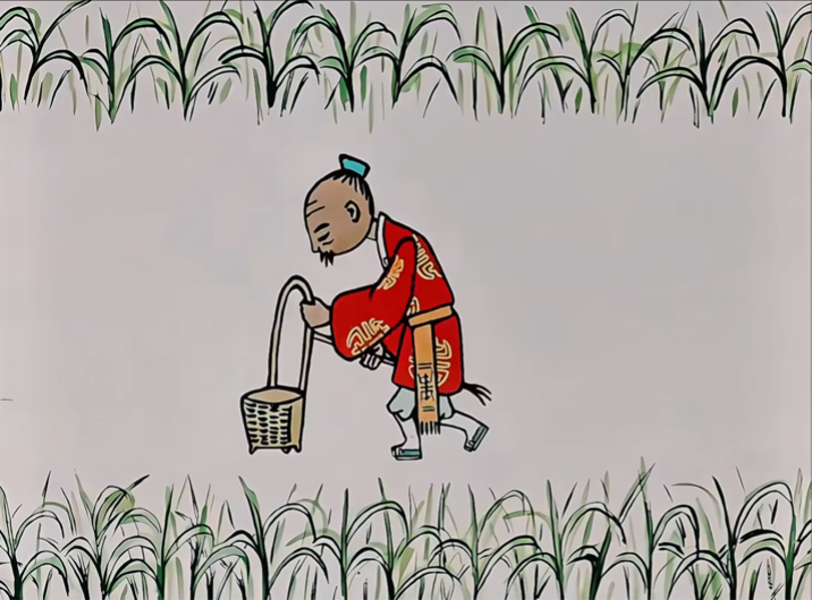
Fig. 7: Flat composition in Silk Waistband (1961)
This painterly orientation, however, carries significance beyond stylistic experimentation. In Qian Yunda’s later cutout film Red Army Bridge, depth becomes an aesthetic-political device that differentiates positive and negative characters, rendering spatial form an active agent of class and moral distinction. A brief synopsis suffices to establish the film’s central contrasts. Adapted from a Hunan revolutionary folktale, the film stages two confrontations: one between landlords’ destructive sabotage of a bridge and its collective reconstruction by villagers and the Red Army, and another between Nationalist retaliation and the villagers’ strategic defeat of their attackers. To visualize political antagonism, the film differentiates character groups through contrasting depth cues. The Red Army and the villagers consistently inhabit a coherent spatial field. For example, in the scene in which they decide to rebuild the destroyed bridge, depth is established through overlapping figure profiles and consistent figure–ground alignment, unifying the villagers on the left and the Red Army on the right within a shared spatial continuum; later, in the Red Army’s departure scene, the soldiers appear at a scale proportionate to the surrounding landscape and are partially obscured by terrain and vegetation, thereby sustaining a stable sense of spatial realism (Fig. 8). By rendering the space inhabited by heroic characters as realistic and coherent, the film articulates a parallel belief in revolutionary camaraderie.

Fig. 8: Two shots featuring coherent spatial depth in Red Army Bridge (1964)
By contrast, scenes featuring antagonistic characters, including landlords, their affiliates, and Nationalist soldiers, privilege graphic arrangement over spatial realism. This is particularly evident in the scene showing a Nationalist officer arranging his troops’ formation in preparation for the attack on Red Army Bridge: four soldiers and their horses are arranged in vertical alignment and uniform scale, and their even spacing overrides any indication of quasi-perspectival depth or spatial recession (Fig. 9). This visual strategy renders the Nationalists as the villainous “them,” sharply distinguished from “us,” a contrast widely mobilized in early socialist Chinese visual culture to demarcate antagonistic camps.[19] The Nationalists are depicted less as inhabiting space than as arranged upon it, displayed anti-perspectivally on the image surface rather than acting within a receding spatial environment. As a result, the enemies of “us”—with “us” encompassing both the oppressed villagers and the Red Army within the diegesis, as well as the film’s contemporaneous audience—are reduced to abstract, disposable signs of antagonism, whose eradication carries little ethical weight. Seen from this perspective, Silk Waistband, the earlier cutout film by Qian discussed above, can also be understood as relying on a spatial strategy similar to that used in Red Army Bridge to construct negative figures. As a satirical allegory, Silk Waistband likewise adopts an anti-realist, graphic spatial configuration in staging the spatial relation between its satirized protagonist and his surroundings, thereby critiquing “the exploiting class’s ideology of idleness, vanity, and indulgent enjoyment.”[20]

Fig. 9: Nationalist troops in line formation in Red Army Bridge (1964)
Despite the positive critical reception that Silk Waistband and Red Army Bridge enjoyed in the early 1960s, the intensified ideological climate that followed the outbreak of the Cultural Revolution in 1966 led to a reassessment of cutout animation, with many works condemned as “poisonous weeds” (ducao 毒草) for their thematic orientations, aesthetic strategies, or both.[21] Red Army Bridge was subject to criticism on both counts: it was accused of distorting the revolutionary struggle at the level of narrative and denounced as reactionary for its stylized, non-realist visual form.[22]These episodes further illustrate how stylistic choices take on ideological significance within the socialist cultural context. Whereas Wan Guchan’s spatial constructions produce a stable and coherent visual field, Qian Yunda’s cutout films, in their anti-realist treatment of antagonistic figures, move toward a more graphic and destabilized spatial order—one that recalls, in a limited sense, Jonathan Crary’s account of the breakdown of classical visual models and their stable representational space.[23] This revolutionary momentum underlying Qian’s stylistic reform of cutout animation likely catalyzed its denunciation when the ideological climate turned sharply leftward in the mid-1960s. Seen in this light, Mao-era cutout animation emerges as more than a folkloric form defined by the materials and motifs it employs: it becomes a critical site for theorizing how media construct reality, or deliberately refuse to do so, through spatial organization. What Wan and Qian’s cutout films ultimately stage is not merely stylistic variation but a politics of seeing. Depth, in turn, transforms folk arts from ornament into immersive, perceptually credible space and regulates the threshold between figures who register as human and those reduced to signs.
[1] Wan Guchan 万古蟾, “Dayuejin zhong jianzhipian de dansheng” 大跃进中剪纸片的诞生 [The birth of cutout animation during the Great Leap Forward], Meishu 美术 [Fine arts], no. 4 (1960): 58. The Chinese term jianzhipian has also been rendered variously in English, including “cut-paper animation,” “papercut animation,” and “papercutting animation”; for the sake of consistency, I use “cutout animation” throughout this essay.
[2] For example, Paola Voci notes that papercut techniques have re-emerged in adapted form in contemporary Chinese animation. See Voci, “Electric Shadows Reloaded: The Post-Digital Animateur, Shadow Play and Handmade Cinema,” Journal of Chinese Cinemas 11, no. 3 (2017): 202.
[3] Aylish Wood, “Re-Animating Space,” in The Animation Studies Reader, ed. Nichola Dobson et al. (New York: Bloomsbury Academic, 2019), 27–29.
[4] Jin Xi, “Kuazhang yu ‘shufu’—Meishupian chuangzuo wenti suibi” 夸张与“舒服”——美术片创作问题随笔 [Exaggeration and “comfort”: An essay on issues in animation production], Dianying yishu 电影艺术 [Film art], no. 1 (1963): 55. Similar views can also be found among younger-generation cutout animators. Pu Yong 浦咏 (b. 1956), for example, identifies cutout animation’s drawbacks as its “spatial limitation and the lack of a sense of depth.” Pu Yong, “On the Art of Papercutting Animation,” trans. Isabel Galwey and Eva Chang, in Chinese Animation and Socialism: From Animators’ Perspectives, ed. Daisy Yan Du (Leiden: Brill, 2022), 98.
[5] Marc Steinberg, “Realism in the Animation Media Environment: Animation Theory from Japan,” in Animating Film Theory, ed. Karen Beckman (Durham: Duke University Press, 2014), 288.
[6] Wan Guchan, “Wode zishu” 我的自述 [My self-narrative], in Shanghai dianying shiliao上海电影史料 [Historical materials on Shanghai cinema], vol. 6, ed. Shanghai dianying shiliao bianjizu《上海电影史料》编辑组 (Shanghai: Shanghai dianyingzhi bangongshi, 1995), 36, 49–50.
[7] Jay Leyda, ed., Eisenstein on Disney, trans. Alan Upchurch (London: Methuen, 1988), 21; Paul Wells, Understanding Animation (London: Routledge, 1998), 22–23.
[8] Wells, Understanding Animation, 23–25; Chris Pallant, Demystifying Disney: A History of Disney Feature Animation (New York: Continuum International Publishing Group, 2011), 40.
[9] Wells, Understanding Animation, 25–26.
[10] This reading is grounded not only in formal analysis but also in the stratified production logic underlying cutout backgrounds. Contemporary descriptions of cutout animation production indicate that such layered compositions were constructed shot by shot, with foreground layers typically carved and pasted onto glass, rear scenic sheets (often termed tianpian 天片, literally “sky sheet”) spray-painted, and jointed paper puppets manipulated separately in an intermediate layer. See Ma Shouqing 马守清, ed., Xiandai yingshi jishu cidian 现代影视技术辞典[Dictionary of modern film and television technology] (Beijing: Zhongguo dianying chubanshe, 1998), 411–14.
[11] Yan Dingxian 严定宪, Meishu dianying donghua jifa 美术电影动画技法 [Techniques of art animation filmmaking] (Beijing: Zhongguo dianying chubanshe, 1981), 128–34.
[12] John White, The Birth and Rebirth of Pictorial Space, 2nd ed. (Boston: Boston Book and Art Shop, 1967), 215.
[13] Wan Guchan, “Wode zishu,” 34–35.
[14] Wu Hung 巫鸿, “Kongjian” de meishushi “空间”的美术史 [The art history of space], trans. Qian Wenyi 钱文逸 (Shanghai: Shanghai renmin chubanshe, 2018), 32.
[15] Wu, “Kongjian” de meishushi, 55.
[16] For discussions of “national style” in Mao-era animation, see Sean Macdonald, Animation in China: History, Aesthetics, Media (London: Routledge, 2016), 3–4, chaps. 3–4; and Daisy Yan Du, Animated Encounters: Transnational Movements of Chinese Animation, 1940s–1970s(Honolulu: University of Hawai‘i Press, 2019), 13–19, chap. 3.
[17] The Golden Conch was originally planned under Wan Guchan’s direction; however, owing to his health problems, the film was largely completed by Qian Yunda in collaboration with Hu Jinqing 胡进庆, Qian Jiaxing 钱家骍, and Shen Zuwei 沈祖慰. Out of respect for Wan, this younger generation of animators nevertheless chose to credit him as the film’s director. See Fu Guangchao 傅广超 and Wang Hongjia 王宏佳, “Bu mofang bieren, bu chongfu ziji—Qian Yunda fangtanlu” 不模仿别人,不重复自己——钱运达访谈录 [Not imitating others, not repeating oneself: An interview with Qian Yunda], in Shenwei donghuaren: Shanghai meiyingren koushushi 身为动画人:上海美影人口述史 [Being an animator: An oral history of the Shanghai Animation Film Studio’s animators], vol. 1, ed. Fu Guangchao (Beijing: Zhongguo chuanmei daxue chubanshe, 2022), 248–49, 263.
[18] “Bu mofang bieren, bu chongfu ziji,” 247.
[19] Chang-tai Hung, Mao’s New World: Political Culture in the Early People’s Republic (Ithaca: Cornell University Press, 2010), 157.
[20] Han Yu 韩羽, “Xihua, donghua—Yu Zhuanji wenxue bianzhe Zhou Jinsheng duitan lu” 戏画·动画——与《传记文学》编者周进生对谈录 [Caricature, animation: A Conversation with Zhou Jinsheng, editor of Biographical literature], abridged, in Han Yu wenji 韩羽文集 [The collected writings of Han Yu] (Beijing: Wenhua yishu chubanshe, 2007), 407.
[21] Li Baochuan 李保传, Zhongguo jianzhi donghua shi 中国剪纸动画史 [A history of Chinese cutout animation] (Guangzhou: Lingnan meishu chubanshe, 2022), 80.
[22] Li Baochuan, Zhongguo jianzhi donghua shi, 80; David Ehrlich with Tianyi Jin, “Animation in China,” in John A. Lent, ed., Animation in Asia and the Pacific (Bloomington: Indiana University Press, 2001), 12.
[23] Jonathan Crary, Techniques of the Observer: On Vision and Modernity in the Nineteenth Century (Cambridge, MA: MIT Press, 1990), 23–24.
Bio:
Yuzhe Li 李煜哲 is a Shuimu Scholar Postdoctoral Fellow in the School of Humanities at Tsinghua University. She received her PhD in Modern Chinese Literature and Film from the University of Wisconsin–Madison. Her research explores modern Chinese literature and cinema through the lenses of media history and material culture, with particular attention to cultural labor and the reconfiguration of skill and craftsmanship in the making of socialist culture.
