By Chen Hailu; translated by Yixing Li
The Shanghai Animation Film Studio only made four analog ink-painting animated films, including Little Tadpoles Look for Mama (1960), The Herd Boy’s Flute (1964), The Deer Bell (1982), and Feelings of Mountain and River (1988). Since 1988, the studio did not produce any ink-painting animated films because the making of an ink-painting animated film is very time-consuming and expensive.[1] To revive this artform in the digital age, the Shanghai Animation Film Studio, which is now part of the Shanghai Film Group Corporation, embarked in 2013 on an ambitious project of making Goral Flying 斑羚飞渡, the first CGI ink-painting animated feature film in greater China (Fig 1). The film has been in the making for more than ten years, and it was scheduled to be released in 2023 (now postponed to summer/fall 2025). Once released, Goral Flying will become a milestone in history of Chinese animation.
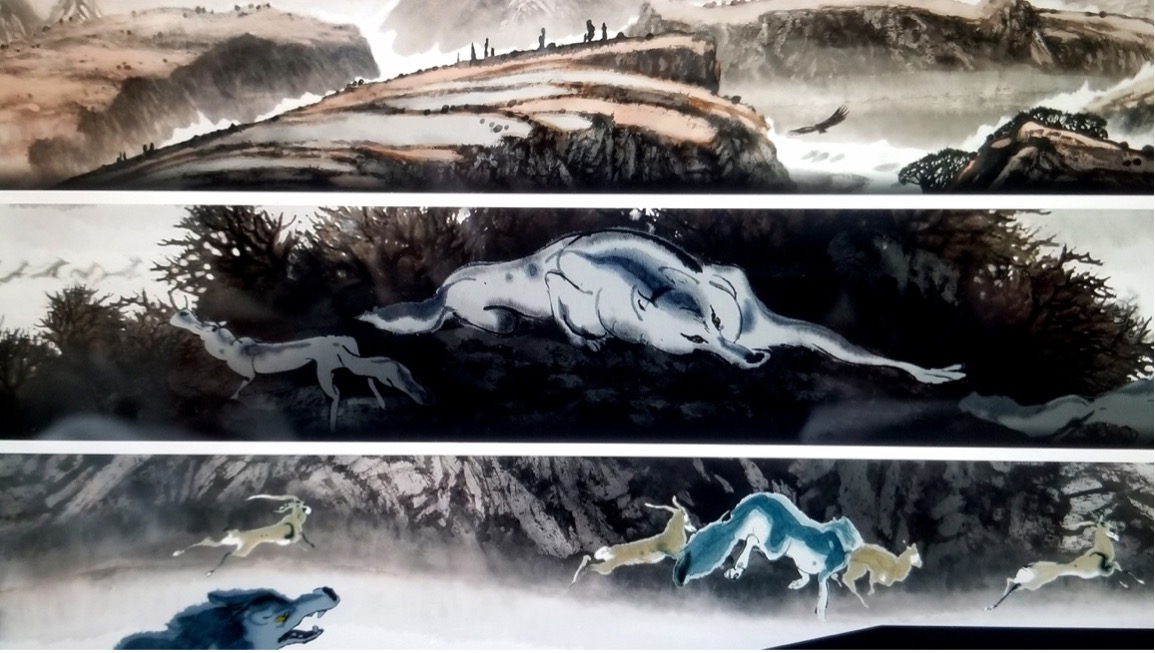
Fig 1: Stills from Goral Flying
The story of the film is adapted from Shen Shixi’s short stories, Goral Flying and Red Nanny Goat.[2] Shen Shixi’s short story Goral Flying portrays a herd of gorals in a desperate situation. The head goral, in face of the crisis, displays extraordinary wisdom, courage and spirit of self-sacrifice, earning a chance for the survival of the breed. In a life-and-death situation, it sacrifices half of the population to save the other half, thus rescuing the younger gorals from their demise. In another work of Shen, Red Nanny Goat, a female wolf dies in labor and leaves behind her suckling wolf cubs. The male wolf, to save the cubs, uses all his means to capture a red goat and wants it to nurse its offspring in place of the female wolf. To protect the cubs from hunters, the male wolf sacrifices itself by luring the hunters away and eventually getting shot to death. That leaves the kind natured red goat to nurture the fierce natured wolf cubs.
It is understood that the early drafts of the script envisioned the red goat as the protagonist, stitching the two stories above together. The story is different from the traditional Shanghai Animation Film Studio works in the last century, which presented innocent fairytales catered wholly to children and youth. This time, the director wishes to use the framework of the goat-and-wolf conflict to illustrate human nature, commending the good and criticizing the evil. Therefore, it should be defined as an animated film catered to adults. For example, the wolves’ nature portrayed in the story is ferocious, selfish and cunning on one hand, but brave and self-sacrificial on the other. Similarly, the goats’ nature is mediocre, timid and conservative, yet united, reflective and rebellious. These factors drive the plot forward and invite the audience to explore the complicated and conflicted inter-species relationship, thus depicting the complexity and volatility of human nature, bringing more depth into the story.
Themes
It is understood that the story is structured on two thematic levels:
First, the story calls for “wolf nature.” The female goat (originally the Red Nanny Goat) is imprisoned by the big male wolf and forced to nurse the wolf cub who has lost its mother. She is estranged from her breed and feels painfully isolated. However, in a wolf-human conflict, she sees the valuable side of “wolf nature”: the big male wolf is willing to sacrifice its own life to lure the hunters away and protect its cubs. She realizes that this spirit is exactly what is lacking in the meek and insipid “goat nature”—implying the “awakening” of the goats. She decides to bring this seed of philosophy back to the goat herd and reform its offspring and colony.
Second, the story sings praises for motherly love and maternal instinct. Usually, maternal instinct is displayed through nursing and participating in the growth of the cubs. In this story, the female goat is endowed with two roles: a mother and a nanny. Forced to be the nanny of a wolf cub, who is originally her enemy, the goat’s attitude transforms gradually from hatred to pure and unreserved motherly love. Her strong maternal instinct overcomes the inherent hatred and narrow-mindedness defined by her identity. On the other hand, as the wife of the head goat and the mother of the new head goat (her son), her maternal instinct is unleashed on a higher level. She channels it towards the reformation of the goat herd, stepping forward when the herd faces a dire crisis, encouraging everyone to face the adversity bravely and leading the herd out of the desperate circumstances with her wisdom, courage and sacrificial spirit.
Through the portrayal of motherly love and maternal instinct, the film redefines love, bravery and self-help. It also paints the awakening, redemption and fight for survival of a colony.
Artistic Pursuit
In the trailer published by the Shanghai Animation Film Studio, we observe that this film has inherited the artistic conception and tradition of the studio’s ink-painting animation developed since Little Tadpoles Look for Mama (1960), and also made innovative explorations. In terms of film media, this film mainly uses two-dimensional animation, but also incoporates production methods from three-dimensional animation. The film’s creators have been innovative in the following three aspects:
First, it explores the style of ink-painting animation from black-and-white to colored ink. This is a fresh attempt made on the basis of Chinese traditional ink-painting animation. Traditional ink-painting animation uses five shades of ink and the literati painting style which incorporates poetry and painting. This is apparent in the first ink-painting animated film, Little Tadpoles Look for Mama and the other three ink-painting animated films. On the contrary, in Goral Flying, the director wants to revamp the artistic presets. This film breaks through the tradition of five shades of black-and-white ink and shifts to colored ink. Each scene showcases intricate and magnificent landscapes, suiting the demands of the blockbuster era and the contemporary aesthetic context.
Second, it explores the storytelling technique of ink-painting animation by embedding metaphors of real life. This film weaves metaphors of the real world into its narrative, such as “goat nature” and “wolf nature” that correspond to contemporary life, the commendation of courage and sacrificial spirit, and the tribute to maternal instincts. The use of such narrative strategies lends philosophical depth to the storytelling in this film, and gives it a dimension of reflection on modern society. In addition, the film seeks to unify its storytelling strategies and artistic expression on the basis of existing ink-painting animation. Shi Yi, the director, has said, “The storytelling technique will be highly unified with the unique style of ink painting. We hope that this will be a brave attempt in the innovation of ink-painting animation.”
Third, it makes a breakthrough in expression through the use of psychoanalysis and surrealism. There have been many breakthroughs in the approaches of expression used in this film. From the traditional realism used, the film has shifted to abstract expression and employed elements of psychoanalysis and surrealism. In Chinese contemporary animation, psychoanlaysis and surrealism usually appear in independent animation and experimental animation but have hardly been used in mainstream theatrical film productions. This time, we can witness this innovation in Goral Flying.
The thorough planning of the film began in 2015, and its mid-stage production commenced in 2019. It is anticipated to be completed by the end of 2023. Just like all other Chinese animated films, it has faced the same, if not more, hardships and adversity. To start with, the creators of the film had spent a tremendous amount of energy settling the script, themes and aesthetic design. In terms of funds, despite receiving an initial investment of 15 million (about 2,217,000 US dollars) from the Shanghai Cultural Foundation in 2018, fund shortage was still severe in the later stage. During the production stage, a series of obstacles have been encountered: the lack of coordination between the ink-painting aesthetic design and set production, the lack of two-dimensional key animation production force, and the impact of the Covid-19 pandemic after China relaxed its preventive measures. The director Shi Yi said: “The various scenarios we encountered have highlighted the particular importance of reconstructing a creative team. The creative concept and ability of the Shanghai Animation Film Studio need an opportunity to be renewed. We need to find breakthroughs and innovation in our tradition. We still have so much work to do.”
Let us patiently anticipate the speedy completion of Goral Flying. We are certain that this full-length ink-painting animated film will grant the audience a refreshing audio-visual experience. With that, we are also hopeful that the Shanghai Animation Film Studio will launch into a whole new era of Chinese-style animated films.
[1] See Daisy Yan Du, “Chapter 3: Inter/National Style and National Identity: Ink-Painting Animation in the Early 1960s,” Animated Encounters: Transnational Movements of Chinese Animation, 1940s-1970s (Honolulu: University of Hawai‘i Press, 2019), 114-151.
[2] Shen Shixi is the pen name of Shen Yiming. He was born in Shanghai in 1952, and his ancestral home is Cixi, Zhejiang. He is a member of the Chinese Writers Association, and a council member of the Shanghai Writers Association. He has published more than five million words, and the bulk of his creative works is novels related to animals. He has won various awards such as the National Outstanding Children’s Literature Award of the Chinese Writers Association, the China Book Prize, the Bing Xin Prize for Children’s Literature Works as a New Writer, and the Taiwan Yang Huan Children’s Literature Award. He is known as the “King of Chinese Animal Novels.” His work Goral Flying won the first Chinese Literature award from People’s Literature Publishing House, and was selected to be part of the Chinese Language textbook for junior high school students by People’s Education Press (Lesson 27, Unit 6, Junior High School Grade One, second semester). Goral Flying was published by Blue Sky Press in 2006. Red Nanny Goat was published by Tiantian Publishing House in 2010.
Bio:
CHEN Hailu holds a master’s degree in experimental animation from a collaborated course by Central Academy of Fine Arts and CALArts. In her early years, she worked as a key animator and executive director at the Shanghai Animation Film Studio. In 2010, she went on to teach at East China Normal University. Her independent animation works have received Cyber Sousa Award, Golden Dragon Award, KingBonn Award and so on. They have been showcased at more than 30 international animation and short film festivals, including China Onscreen Biennial, Berlin International Short Film Festival, International Animation Festival of Brazil, and “A Tradition Re-Interpreted—New Work by Contemporary Chinese Artists” at Cleveland State University in USA. In 2017, she was selected to be part of the Director Supporting Program in China International New Media Short Film Festival. In 2018, she was invited to attend the Tricky Women Animation Festival in Vienna, Austria. In 2019, she was amongst the panel of judges for the KingBonn Award. Her representative animated films include Conversation (2008), Divergence (2013), and Peach Blossom Fish (2018).
Yixing Li was bilingually educated in Singapore and graduated from Peking University with a BA in Chinese language and literature and an MFA in creative writing. She is currently a Chinese teacher in the Ministry of Education, Singapore, and has taught at secondary and pre-university level. As a freelance translator, she has done translation work for essays, subtitles, legal documents and more.
